Winter light and the short afternoons it brings
Reference library · 1080 words

The first thing a newcomer notices about a Melbourne winter is not the cold. It is that the afternoon ends while there is still a great deal of afternoon left to get through. By late June the sun is gone before half past five, offices empty into darkness, and the walk to the tram happens under streetlights. The days are short, the sun never gets high, and the sky is grey more often than not. That combination, rather than temperature, is what makes winter here a distinct condition.
Melbourne sits at about thirty eight degrees south, roughly the latitude of Athens or San Francisco in the other hemisphere. At the June solstice the city gets a little under nine and a half hours between sunrise and sunset, against close to fifteen hours at the December solstice. That is a swing of more than five hours across the year, enough to be structurally noticeable but nothing like the extremes of northern Europe. What matters as much as the length is the angle. At midday in June the sun stands only around twenty nine degrees above the horizon, so even at its highest it is raking across the city rather than shining down into it.
The transition is made abrupt by daylight saving. Victoria puts its clocks forward on the first Sunday in October and back on the first Sunday in April, which means that on a single Sunday in autumn the sunset jumps an hour earlier. Nothing about the sun has changed; the clock has. But the felt experience is that winter arrives overnight in the first week of April, weeks before the weather actually turns, and Melburnians speak about it as though it were a meteorological event.
Grey, not cold
Here is the correction that surprises most visitors: Melbourne is not a cold city by international standards. The lowest temperature ever recorded in the city is minus 2.8 degrees, set in July 1869, and snow in the central city is so rare that its last recorded occurrence was in 1986. Typical winter mornings sit a few degrees above zero and typical afternoons in the low to mid teens. Compared with almost any northern European or North American city at a similar latitude, that is mild.
What Melbourne actually has is cloud, damp and wind. It is Australia's cloudiest capital, with fewer than fifty genuinely clear days a year and around a hundred and thirty nine days on which some rain falls. Annual rainfall averages a little over six hundred millimetres, well under Sydney's, which is why the reputation for a wet city is misleading: Melbourne is not wet so much as persistently drizzly. Winter is the season with the most rain days and among the least rainfall per event, a combination that produces weeks of low grey sky with nothing dramatic happening in it.
The second half of the explanation is architectural. Melbourne's housing stock was largely built without insulation and, for most of its history, without central heating. Weatherboard houses on stumps and single skin brick veneers lose heat quickly, and until recently the standard response was a gas heater in one room and a closed door. That is why a city with mild winter temperatures produces people who complain bitterly about the cold: the numbers describe the outdoors, and the indoors is often not much warmer. Modern building standards have changed this for new construction, but a very large share of the city still lives in houses designed for a climate nobody bothered to check.
What the light does to the city
Because the sun sits low, it comes in sideways, and the grid decides where it lands. Robert Hoddle's 1837 survey aligned the long streets parallel to the river, about seventy degrees off true north, so in winter the low sun runs down Collins Street, Bourke Street and Little Bourke Street in the late afternoon and floods them with a flat orange light while the cross streets stay in shadow. Photographers know this. So does anyone who has stood at the corner of Swanston and Collins at four in the afternoon in July and been briefly blinded.
The street trees participate. Melbourne's elms, planes and oaks are deciduous, which was never an accident: European species were planted along Royal Parade, Victoria Parade and St Kilda Road in part because they give dense shade in summer and let the sun through in winter, which is exactly what a temperate city wants from a street tree. From June to August those avenues are bare grey scaffolding, and the footpaths beneath them get whatever light there is. The native eucalypts in Royal Park and Yarra Park hold their leaves all year and do not perform this trick at all.
The four season year that puts winter in June, July and August is itself an imported convention, applied to a place it fits imperfectly. Wurundjeri Woi Wurrung and Boon Wurrung seasonal knowledge tracked country through indicators such as the flowering of particular plants and the movement of particular animals rather than through a calendar divided into four equal blocks. Anyone who has experienced a mild sunny week in the middle of a Melbourne July, or a fortnight of grey in November, has felt the limits of the imported model.
How the city responds
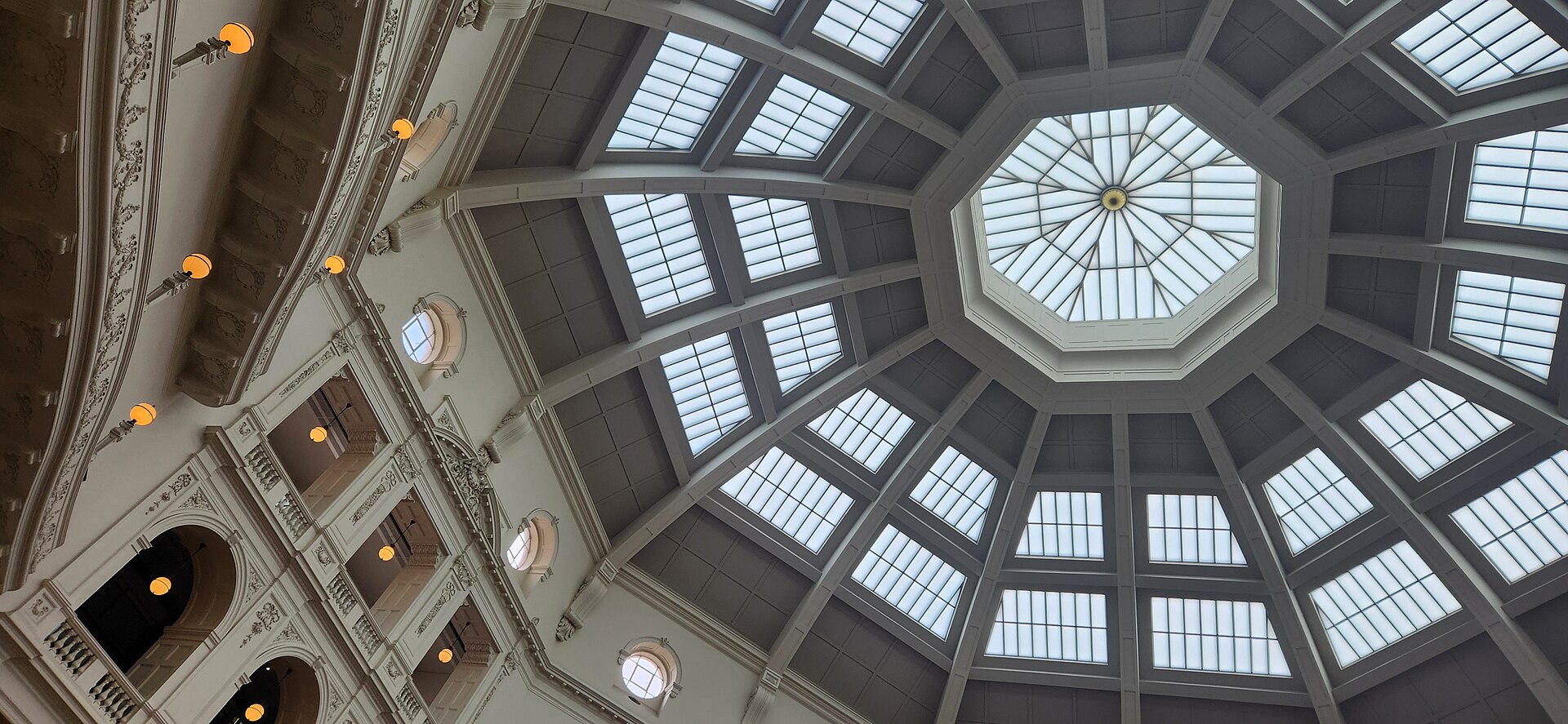
Melbourne's winter behaviour is essentially a migration indoors, and the city has an unusual amount of indoors to migrate into. The domed reading room of the State Library on Swanston Street, the National Gallery of Victoria on St Kilda Road, the arcades between Bourke Street and Little Collins Street, and the enormous number of small bars and cafes tucked into the lanes all absorb people who in summer would be in a park. Football season runs from March to September, which means the coldest months are also the months with somewhere to be on a Saturday. Cinemas, theatres and a comedy festival in April do the rest.
One habit is worth adopting. Because clear days are scarce, Melburnians treat a sunny winter afternoon as an obligation rather than an opportunity, and the parks fill in a way that a visitor from a sunnier city finds bewildering. If the sky is blue on a Saturday in July, go outside then. The next chance may be a fortnight away, and the light, low and gold and coming in almost horizontally along a street grid laid out by a colonial surveyor, is genuinely one of the best things this city does.
References
- WikipediaClimate of Melbourne
- eMelbourne, The Encyclopedia of Melbourne OnlineTrees
- eMelbourne, The Encyclopedia of Melbourne OnlineElm Trees
- eMelbourne, The Encyclopedia of Melbourne OnlineGrid Plan
- eMelbourne, The Encyclopedia of Melbourne OnlineHousing
This is a reference article, written from the sources above. It is background, not news reporting.