Why the flat white matters here
Reference library · 1097 words
.jpg)
Order a flat white in Melbourne and you will get a drink of roughly one hundred and fifty millilitres, in a ceramic cup, made from a double shot of espresso with steamed milk poured through it so that the foam is folded into the body rather than sitting on top as a separate layer. It is not a small latte and it is not a cappuccino without chocolate. The distinction is textural: a flat white should have a thin, glossy, uniform microfoam that carries the milk and the coffee as one thing. Whether a given cafe achieves that is the fastest available test of whether the person on the machine knows what they are doing, which is precisely why Melbourne cares about it so much.
The drink matters here for a reason that has almost nothing to do with the drink and almost everything to do with migration. Melbourne's coffee culture is a direct consequence of the postwar arrival of large numbers of Italian and Greek migrants, and of the small businesses they opened in a city that at the time drank tea and instant coffee. The espresso bar was not invented as a lifestyle product. It was a community institution: somewhere to read a newspaper in your own language, hear news from home, arrange work and be among people who were not treating you as a foreigner.
What actually happened, and what did not
The popular version has espresso arriving in Melbourne in the 1950s and transforming everything. The record is messier and more interesting. Coffee stalls served city workers on the streets from the 1850s. By the late 1930s a substantial share of Melbourne's registered cafes were coffee or tea lounges, in the Continental manner, and espresso machines already existed in the city, generally tucked away in restaurant kitchens or in Italian grocers rather than displayed at a counter. The machine itself dates from the beginning of the twentieth century, patented in Milan by Luigi Bezzera, and it was substantially improved after the Second World War when spring lever designs began producing the crema modern drinkers expect.
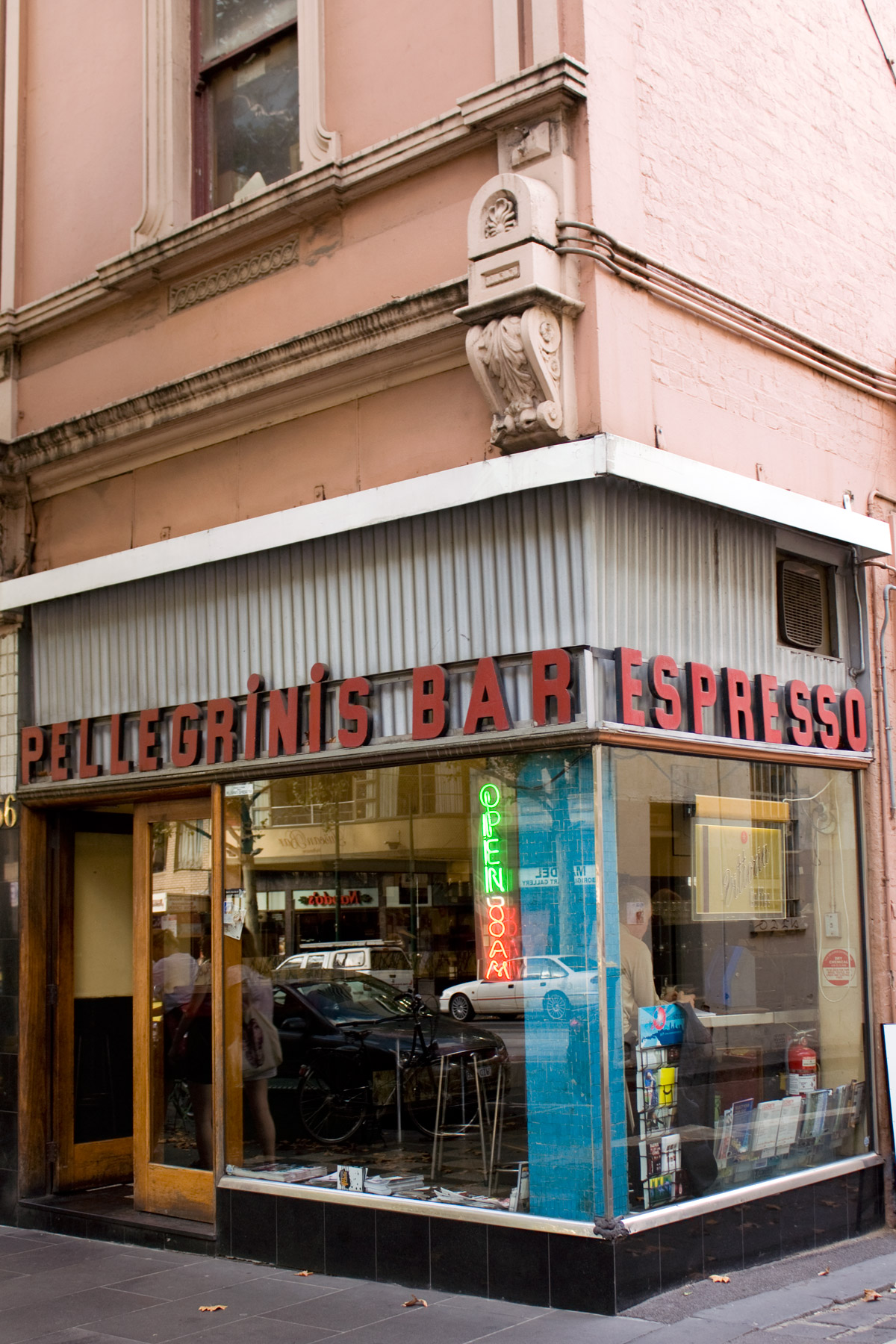
So the claims you will see on cafe walls deserve a sceptical eye. Several Melbourne establishments assert that they installed the city's first espresso machine, most famously the espresso bar that opened at the top end of Bourke Street in the mid 1950s and which is still there, still with its long formica counter and its cash register at the end. It is a genuinely important place and its longevity is not in doubt. The claim to being first is, and the encyclopedic sources are clear that espresso equipment was in Melbourne well before the 1950s. What the 1950s and 1960s did was move the machine from the back room to the front window and make it public.
Where the transformation is undeniable is geography. Lygon Street in Carlton, close to the university and to a large Italian population, became the visible centre of the change, with its cafes, its Italian grocers and its social clubs. Sydney Road in Brunswick did similar work further north. Oakleigh in the south east developed one of the most concentrated Greek commercial strips in the country, and its cafes still sell frappe and Greek coffee alongside espresso. Later waves added their own: Victoria Street in Richmond became a Vietnamese strip where the coffee is a slow drip through a phin with condensed milk, and Footscray in the west carries Vietnamese, Ethiopian and East African trade, including Ethiopian coffee ceremonies that have nothing to do with the Italian tradition at all.
Why the independents held the ground
The other thing that distinguishes Melbourne is a negative fact: the international chains failed here. Starbucks entered Australia at the turn of the millennium, expanded quickly, and closed the large majority of its Australian stores in 2008. The usual explanation is that Australians had better coffee already, which is partly true and partly self flattery. The more precise explanation is structural. By 2000 Melbourne had several thousand independent cafes with two generations of accumulated skill, an established espresso format that customers already preferred, and a wholesale roasting industry supplying them. A chain offering large sweetened milk drinks at a premium price was entering a market that was both saturated and technically ahead of it.
That roasting industry is the unglamorous engine of the whole thing. Melbourne cafes overwhelmingly buy from local roasters rather than from national distributors, and a roaster's relationship with a cafe usually includes machine servicing, staff training and blend adjustment. The result is a dense technical culture in which the person making your coffee has probably been trained by the company that roasted it, and in which small differences in extraction are treated as consequential. It also produced its own vocabulary. The magic, a shorter and stronger drink of about one hundred and fifty millilitres built on a double ristretto, appears to be a Melbourne coinage and is still not widely understood outside the south east of Australia.
The argument nobody wins
As for who invented the flat white, the honest answer is that nobody knows and the two countries with the strongest claims are not going to settle it. Competing accounts place its emergence in Australian and New Zealand cafes during the 1980s, with named baristas on both sides of the Tasman claiming to have coined or standardised it, and no contemporaneous documentation decisive enough to close the question. Melbourne's position in that argument is weaker than its confidence suggests; Sydney and Wellington both have better documented claims to the name. What Melbourne can claim, without much fear of contradiction, is the depth and consistency of the practice rather than the invention of the label.
For a newcomer, a few practical notes follow from all this. Order by size and drink rather than by cup, because a flat white and a latte in this city differ mainly in vessel and foam depth and a cafe will not be offended if you ask which they prefer. Expect to pay a price that has risen sharply in recent years, and understand that the margin on a single cup is thinner than it looks once rent, milk, wages and green bean costs are counted. And if you want to see the older tradition rather than the contemporary one, walk into a Greek cafe in Oakleigh or an Italian one on Lygon Street on a weekday morning and watch how long the men at the front table make one cup last. That is what the trade was for before it became something Melbourne told visitors about.
References
- eMelbourne, The Encyclopedia of Melbourne Online, University of MelbourneCoffee
- eMelbourne, The Encyclopedia of Melbourne Online, University of MelbourneItalians
- eMelbourne, The Encyclopedia of Melbourne Online, University of MelbourneRestaurants and Cafes
- WikipediaFlat white
- WikipediaCoffee in Australia
This is a reference article, written from the sources above. It is background, not news reporting.