The laneway espresso bar as an institution
Reference library · 1049 words
.jpg)
The image is fixed in every guidebook: a narrow bluestone lane off a main street, a doorway barely wider than a wardrobe, a machine hissing, four stools, and a queue of people who all appear to know the barista. Degraves Street and Centre Place run off Flinders Street; Block Place cuts between Little Collins Street and the Block Arcade; Hardware Lane has been given tables and umbrellas along most of its length. The scene is real, it is genuinely good, and almost everything commonly said about its history is wrong.
Start with the lanes themselves. They were not built for cafes or for anything resembling public life. When Governor Bourke forced rear access lanes into Robert Hoddle's 1837 town plan, he did it so that carts could reach the back of warehouses and shops. For the next century and a half the lanes of central Melbourne were service corridors: deliveries, workshops, factory overflow, night soil collection and rubbish dumping. By the mid 1850s there were around 80 named lanes and 112 rights of way in the centre, many of them privately owned, and several of them, notably the Little Lonsdale Street area, carried reputations for poverty and crime that lasted into the twentieth century. The romantic reading of the laneway as an old bohemian quarter is a retrospective invention.
Espresso arrived late, and not from Melbourne
The second myth is that Melbourne invented or pioneered espresso culture. Espresso was invented in Milan, where Luigi Bezzera patented his machine in 1901, and the modern lever machine that produces crema was developed by Achille Gaggia in Italy after the Second World War. New York had a machine installed in the late 1920s. Melbourne had early units by the 1930s, but they sat in restaurant kitchens, at Florentino for instance, or in small Italian grocers, and were not part of any public ritual.
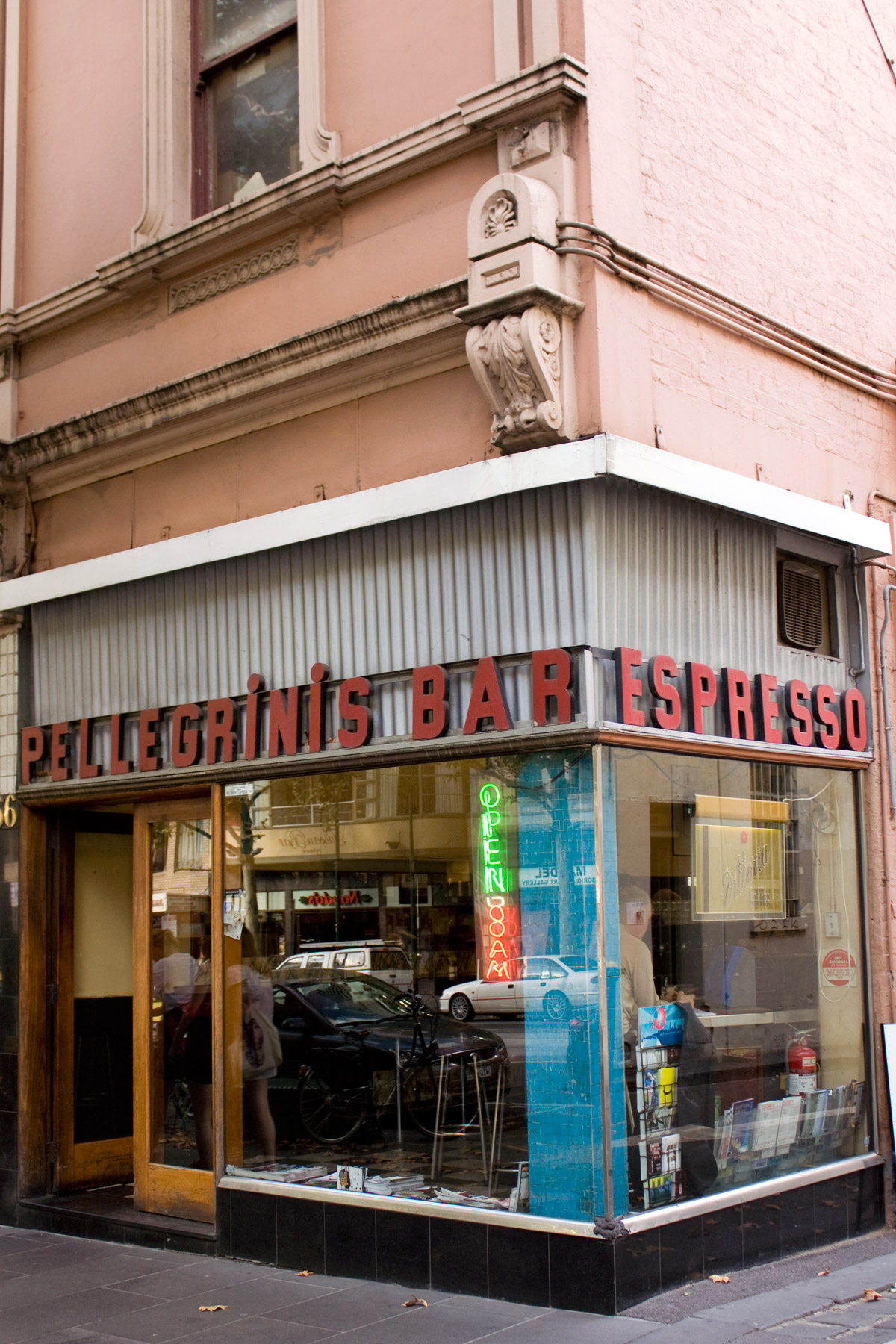
The change came in 1953, when a Melbourne father and son secured Australian manufacturing rights to Gaggia machines and opened a bar called Il Capuccino in St Kilda. Machines spread quickly from there to the University Cafe on Lygon Street in Carlton and to Pellegrini's on Bourke Street, both of which are still trading and both of which have reasonable claims to be among the earliest espresso bars in the city. Melbourne's first kerbside cafe, with tables actually on the footpath, opened at the Oriental on Collins Street in 1958. Note the dates. The espresso bar is a postwar institution, and its founding generation were Italian and Greek migrants, not artists.
Those migrants shaped particular streets rather than the city as a whole. Lygon Street in Carlton and Brunswick Street and Gertrude Street in Fitzroy filled with espresso bars, cabarets and clubs from the mid 1950s. Fitzroy's Greek population went from a few hundred at the 1947 census to several thousand by the mid 1960s, and Italian cafes in Carlton often took over premises that had housed Jewish cafes a generation earlier. The coffee bar was, first of all, a place where men who worked long shifts could speak their own language in public.
Why the lanes filled up when they did
If espresso arrived in the 1950s, why did the laneway cafe only become the city's signature in the 1990s and 2000s? Two policy changes explain most of it.
The first was liquor licensing. Victoria ran a restrictive system for most of the twentieth century, including the notorious six o'clock closing imposed in 1916. A government commissioned review of licensing reported in 1988 and led to reforms that made it far easier for small venues to obtain a licence. That single change made a tiny room off a lane a viable business rather than a legal impossibility, and it is the direct ancestor of both the laneway coffee bar and the small bar.
The second was residential population. The city centre had emptied out after office hours for decades. From the early 1990s the City of Melbourne actively encouraged conversion of old warehouses and offices into apartments, and the resident population of the central grid rose from a very low base to tens of thousands. Cafes follow residents. Once people lived above the lanes, someone would open at seven in the morning below them.
Street art followed the same logic. Hosier Lane and ACDC Lane, which was renamed in 2004 after the band, became destinations only once there were enough people walking through to see them. The council's decision to formally name and celebrate lanes, and to permit painting in some of them, was a deliberate act of city marketing rather than an organic accident.
What the institution actually is
Strip away the mythology and something more interesting remains. Melbourne's coffee culture is unusual less for its age than for its ordinariness. Espresso became the default rather than a specialty. A takeaway coffee is a normal part of a normal morning for a large share of the working population, and the standard of the average cup, in an average suburban shop with no design ambitions at all, is high enough that visitors from cities with famous coffee scenes tend to remark on it.
It also carries an older lineage than the espresso machine. Street coffee stalls served city workers cheap breakfasts and late night refreshment in the 1850s. By the late 1930s Melbourne had something like 450 registered cafes, roughly 200 of them serving coffee or tea, mostly percolated. And in the 1880s the city built more than fifty coffee palaces, enormous temperance hotels intended to offer the comforts of a pub without the drink. The Federal Coffee Palace of 1888 had four hundred bedrooms and was among the largest hotels in the country. Almost all of them eventually took liquor licences; the Grand became the Windsor Hotel, which still stands on Spring Street. Those buildings tell you that Melbourne has been organising civic life around coffee, for one reason or another, for a very long time.
The laneway espresso bar, then, is not an ancient tradition. It is a postwar migrant business model, released by a licensing reform in the late 1980s and a residential policy in the 1990s, operating inside service corridors that a governor insisted on in 1837. That is a better story than the one on the postcards, with the advantage of being true.
References
- eMelbourne, The Encyclopedia of Melbourne OnlineCoffee
- eMelbourne, The Encyclopedia of Melbourne OnlineRestaurants and Cafes
- eMelbourne, The Encyclopedia of Melbourne OnlineCoffee Palaces
- eMelbourne, The Encyclopedia of Melbourne OnlineFitzroy
- WikipediaLanes and arcades of Melbourne
This is a reference article, written from the sources above. It is background, not news reporting.