The hook turn and the logic behind it
Reference library · 1100 words
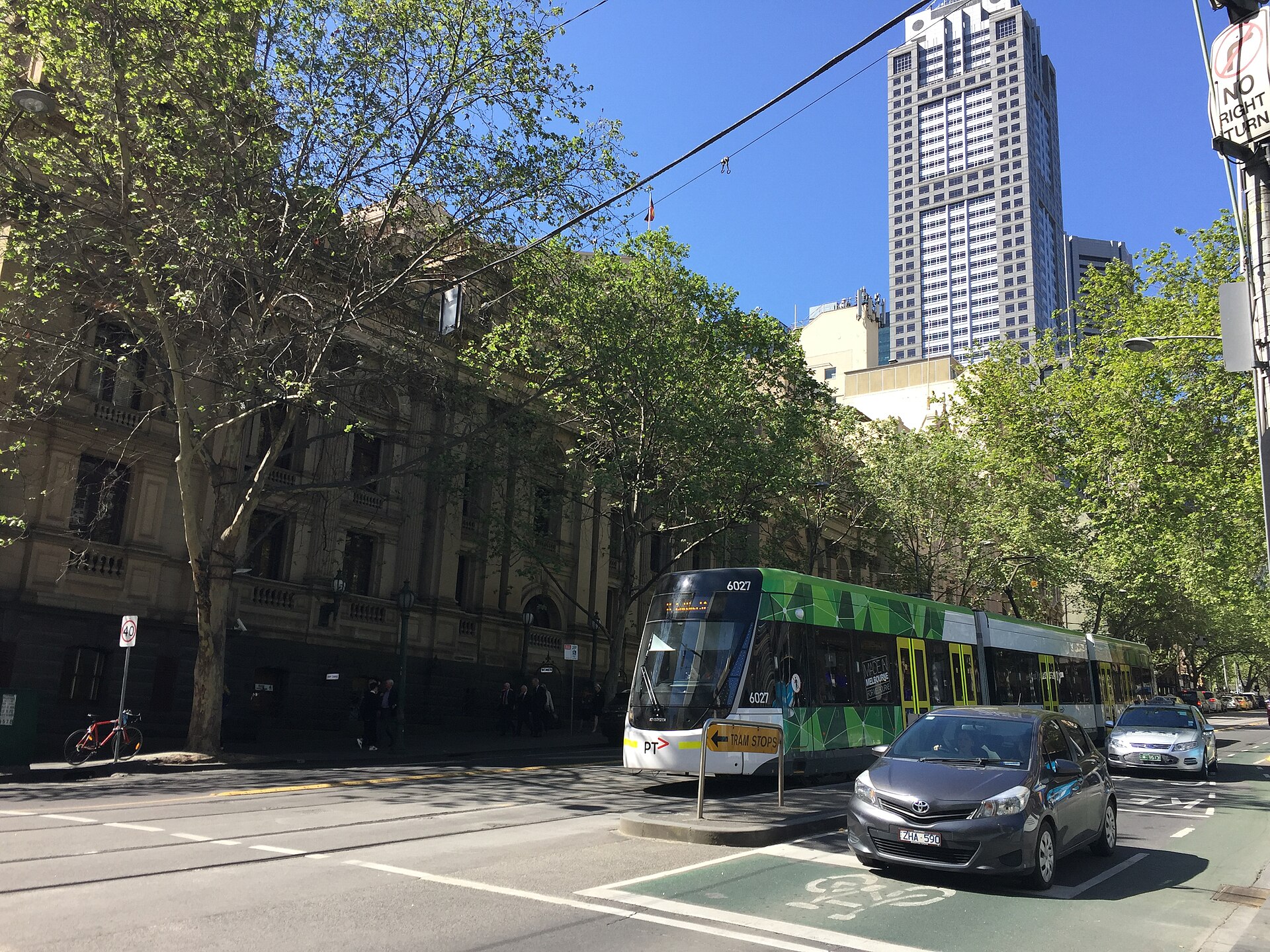

At around thirty intersections inside central Melbourne, a driver wanting to turn right must first move to the far left. The manoeuvre is called a hook turn, it is signed with a black and white plate hung above the intersection reading right turn from left only, and it is the most reliable way to identify a visiting driver, because visitors either refuse to do it or do it in the wrong place at the wrong time with the horn behind them.
The procedure is precise and it rewards being learned properly rather than improvised. Approach in the left lane with your right indicator on, which feels wrong and is correct. Enter the intersection keeping as far left as the line marking allows, and move forward until you are at the far side of the intersection, clear of the pedestrian crossing on the street you are about to enter. Stop there and wait. Watch the traffic signals on the road you are turning into, not the ones you came through. When those lights turn green, complete the turn to the right and go. It feels absurd exactly once.
Why the rule exists
The answer is trams, and specifically the fact that Melbourne's trams run down the centre of the road rather than at the kerb. In an ordinary intersection, a car waiting to turn right sits in the centre of the roadway with its nose across the oncoming lane. In Melbourne, that position is directly on the tram tracks. One car waiting for a gap can therefore hold up a tram carrying more than a hundred people, and behind it a second tram, and behind that a third, until an entire corridor of the network is stalled by a driver looking for a break in traffic.
The hook turn removes the conflict entirely by moving the waiting vehicle out of the tram's path and parking it in a corner of the intersection where it is in nobody's way. It costs the individual driver a little time. It saves the tram, and everyone on it, a great deal. That trade, favouring the high capacity vehicle over the private one, is the whole logic, and it is unusually explicit for an Australian traffic rule.
The arrangement is old. It has its roots in the era when the centre of the roadway was occupied first by cable tram slots and later by electric tramway reservations, and when city traffic regulations required other vehicles to keep clear of the track. The rule was formalised and standardised over the twentieth century, and its survival is a direct consequence of Melbourne having kept its trams when comparable cities tore theirs out. Where the trams went, the reason for the hook turn went with them.
Where it applies, and where it does not
Hook turns are concentrated inside the Hoddle Grid, at the crossings of the north to south streets, Swanston, Elizabeth, Queen and William, with the east to west streets, Collins, Bourke and Lonsdale, and at various other combinations within the grid. There are also a handful outside the centre, in places such as North Melbourne and Carlton where tram routes cross busy roads. This is the crucial point that newcomers miss: a hook turn is never optional and never assumed. It applies only where the sign is present, and where the sign is absent you turn right in the ordinary way from the right lane. Attempting a hook turn at an unsigned intersection is both illegal and dangerous, because nobody behind you expects it.
Cyclists are governed by a different and more permissive version of the same idea. In Victoria a rider may perform a hook turn at almost any intersection, whether or not it is signed, unless a sign specifically prohibits it. For a cyclist the reasoning is not about trams at all but about not having to cross several lanes of moving traffic to reach a right turn lane. Many jurisdictions now provide the same thing under the name two stage turn, often with a painted box on the far corner.
Which brings up a claim worth deflating. Melburnians frequently describe the hook turn as unique to their city. It is not. Two stage right or left turns for cyclists and motorcyclists exist in a number of countries, and Taipei has long used a similar arrangement for its very large scooter population. What is unusual about Melbourne is that the rule applies to all motor vehicles, at signed intersections, in the middle of a major central business district, and has done so for generations. That is genuinely uncommon. Being uncommon is not the same as being unique, and the difference matters if you want to understand the rule rather than simply boast about it.
The details that catch people out
Several things go wrong repeatedly. The first is stopping too early. If you halt short of the far corner you block the pedestrian crossing and the through traffic in the left lane behind you, and you will be told about it. Pull right forward. The second is watching the wrong signals. Your cue is the lights facing the street you are entering, which will go green as the phase changes; if you are still watching the lights you drove under you will sit through the whole cycle. The third is indicating late. Signal right on approach so the driver behind understands why you are drifting left.
The fourth is a matter of nerve. Because the manoeuvre is unfamiliar to most Australians, drivers from interstate often abandon it halfway, either turning right from the right lane at a hook turn intersection or stopping in the middle of the box. If you find yourself in the wrong lane as you approach a hook turn intersection, do not attempt a correction. Continue straight, go around the block, and come back. The grid makes that trivially easy, which is part of why the rule has survived: in a rectangular street network, an unplanned lap costs you three turns and about ninety seconds.
The last piece of context is the rule that sits behind all of this. In Melbourne you must stop and remain stationary behind a tram that has halted at a stop with its doors open, until the doors close and the passengers are clear, unless the stop has a raised platform. Drivers who have absorbed that rule tend to find the hook turn intuitive, because both are expressions of the same civic priority. The city decided long ago that a vehicle carrying a hundred people outranks one carrying you, and it built its traffic law accordingly.
References
- Department of Transport and Planning VictoriaHook turns
- Department of Transport and Planning VictoriaBicycle road rules
- eMelbourne, The Encyclopedia of Melbourne Online, University of MelbourneTrams
- WikipediaHook turn
This is a reference article, written from the sources above. It is background, not news reporting.