Reading Melbourne's tram network like a local
Reference library · 1058 words
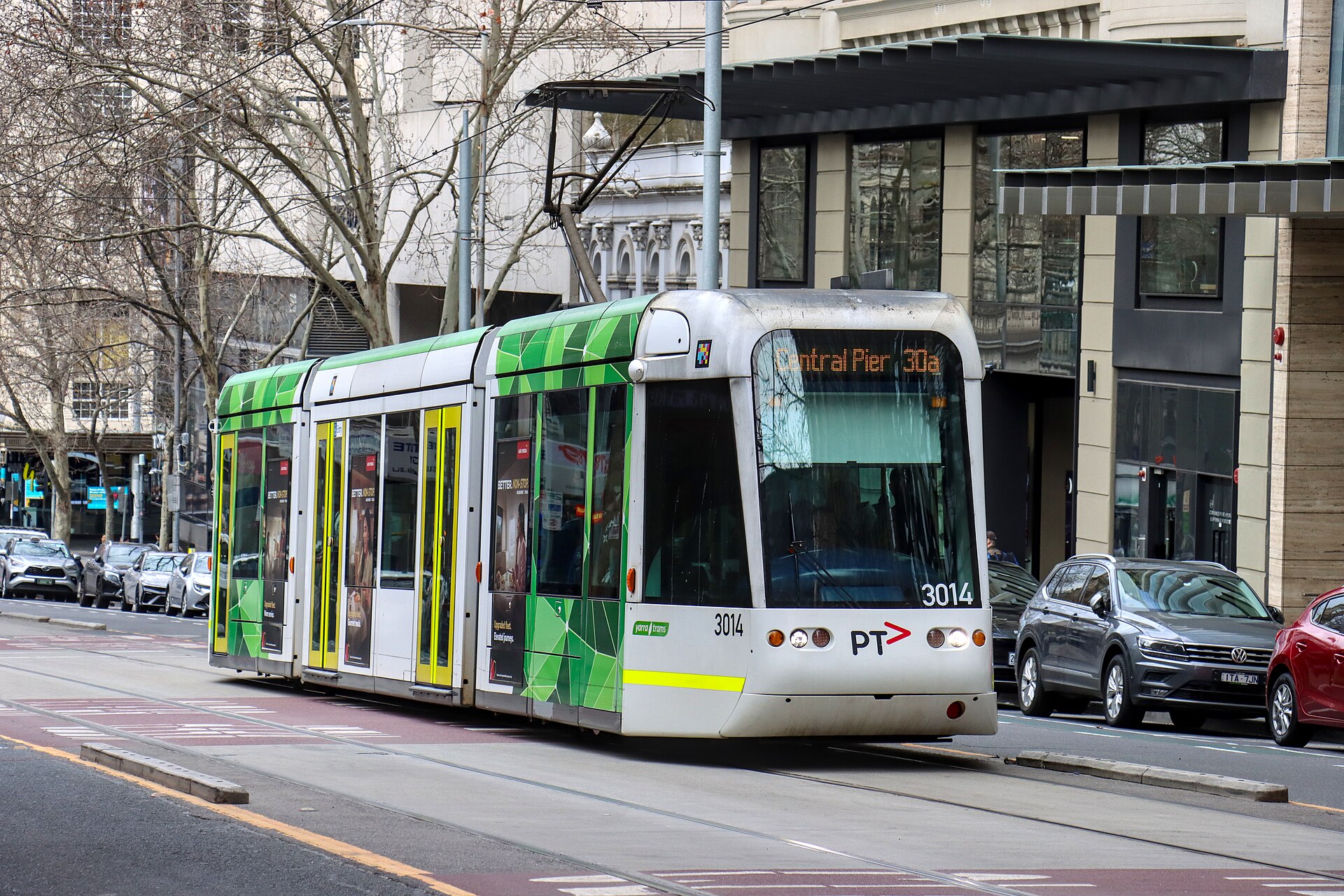

Melbourne runs the largest tram network still operating anywhere in the world, and it is the only Australian city that never tore its trams up. That single fact explains a great deal about how the place feels at street level. Trams are not a heritage attraction bolted onto a modern city; they are the ordinary way hundreds of thousands of people cross the inner suburbs every day, and the network's shape is the fossil record of nineteenth century property speculation. Learning to read it is less about memorising a map than about understanding why the lines go where they go.
Start with the geometry. Melbourne's centre is the Hoddle Grid, the rectangle of streets that the surveyor Robert Hoddle laid out in 1837 on Wurundjeri Woi Wurrung country beside the river the Wurundjeri know as Birrarung. Hoddle gave the city unusually wide main streets, and those widths are the reason trams fit. Swanston Street, Collins Street, Bourke Street, Elizabeth Street and La Trobe Street all carry tracks, and almost every route in the system either crosses the grid or terminates inside it. Radiating outward, the lines follow the arterial roads that were already there in the 1880s: Sydney Road to Coburg, Nicholson Street and Brunswick Street through Fitzroy, Bridge Road and Victoria Street through Richmond, Toorak Road and Glenferrie Road through the eastern suburbs, St Kilda Road and Dandenong Road to the south.
Why the map looks like the 1880s
The reason is that it largely is the 1880s. Melbourne's first mass tram system was a cable network, opened in 1885 and run by the Melbourne Tramway and Omnibus Company. A steam engine in a winding house hauled an endless steel cable through a slot between the rails, and a crew member called the gripman worked a lever that clamped onto the moving cable to make the dummy car go. It became one of the largest cable systems ever built, with roughly seventeen inner suburban routes, and it was laid out to serve and to sell the new subdivisions of the land boom. Where a syndicate wanted to shift allotments, a cable line tended to appear.
Electrification came piecemeal and late. An electric line ran between Box Hill and Doncaster from 1889, an early experiment that did not last, and municipal trusts electrified various suburban corridors in the following decades. Only in 1919 did the state create the Melbourne and Metropolitan Tramways Board, which absorbed the competing operators and rebuilt the cable routes as electric ones. The last cable tram ran on 26 October 1940, along Bourke Street. What survived that consolidation was the corridor pattern, which is why a route today can still trace an alignment chosen by a nineteenth century land agent.
The system nearly went the way of Sydney's. Through the postwar decades tram networks were being ripped out across the English speaking world in favour of buses and freeways. Melbourne's survived partly because the Tramways Board had already invested heavily in a durable standard vehicle, the W class, built from the early 1920s and produced in large numbers, and partly because a long serving board chairman fought hard for the mode. The upshot is that Melbourne kept an asset that most comparable cities spent the late twentieth century regretting having destroyed.
Reading a route number
Numbers are the local shorthand, and a few of them do real work. Route 96, from St Kilda Beach to East Brunswick, is the one to understand first: for much of its length it is not on a road at all but on the reserved formation of two former suburban railway lines, the St Kilda and Port Melbourne lines, converted to light rail in 1987. That is why it is fast. Route 109 runs Box Hill to Port Melbourne and uses the other half of that conversion. Route 86 runs from Bundoora up in the north down Plenty Road and High Street through Northcote and into Docklands. Route 19 runs the length of Sydney Road to North Coburg. Route 11 and route 12 serve Victoria Harbour and the Docklands waterfront. Route 35 is the City Circle, a free loop around the edge of the grid worked by restored W class cars, and it is genuinely useful for orientation even though it is aimed squarely at visitors.
Note what is missing from that list. Several important routes never enter the centre at all. Route 78 runs north to south along Church Street and Chapel Street, stitching Richmond to Prahran and Windsor without touching the grid. Route 82 links Footscray and Moonee Ponds in the west. If you assume every tram goes to the city, you will make the classic newcomer's mistake of travelling in twice the distance you need.
Fares, stops and the etiquette
Ticketing is the myki smartcard. Since the start of 2015 the whole Hoddle Grid and the Docklands and Queen Victoria Market fringes have been a Free Tram Zone, where you touch nothing at all. Outside it you touch on, and on trams within the inner fare zone you do not touch off. That asymmetry catches people out constantly, in both directions: visitors who touch off unnecessarily and lose nothing, and residents who forget to touch on and are fined.
Stops come in two kinds and the difference matters more than it sounds. Older stops are simply a painted patch of roadway, where passengers step down into a traffic lane and rely on drivers obeying the rule that vehicles must stop behind a stationary tram with its doors open. Newer platform stops, often called superstops, raise the kerb to floor height so that the low floor C class and E class trams can be boarded without a step. Accessibility upgrades have been slow and uneven, which is a live political argument rather than a settled achievement, so a wheelchair user still cannot assume a given stop will work.
The rest is manners. Move down inside the car, because Melbourne trams load from several doors and the crush forms at the front. Give up the seats near the doors. Do not lean on the doors of an E class, which will refuse to close and hold up everyone behind you. And on a hot day, remember that only the newer fleet is air conditioned, which is why a W class in February is romantic for about four minutes.
References
- eMelbourne, The Encyclopedia of Melbourne Online, University of MelbourneTrams
- eMelbourne, The Encyclopedia of Melbourne Online, University of MelbourneCable Trams
- eMelbourne, The Encyclopedia of Melbourne Online, University of MelbourneW-Class Trams
- Public Transport VictoriaFree Tram Zone
- WikipediaMelbourne tram route 96
This is a reference article, written from the sources above. It is background, not news reporting.