Four seasons in one day, the local joke that's true
Reference library · 1098 words
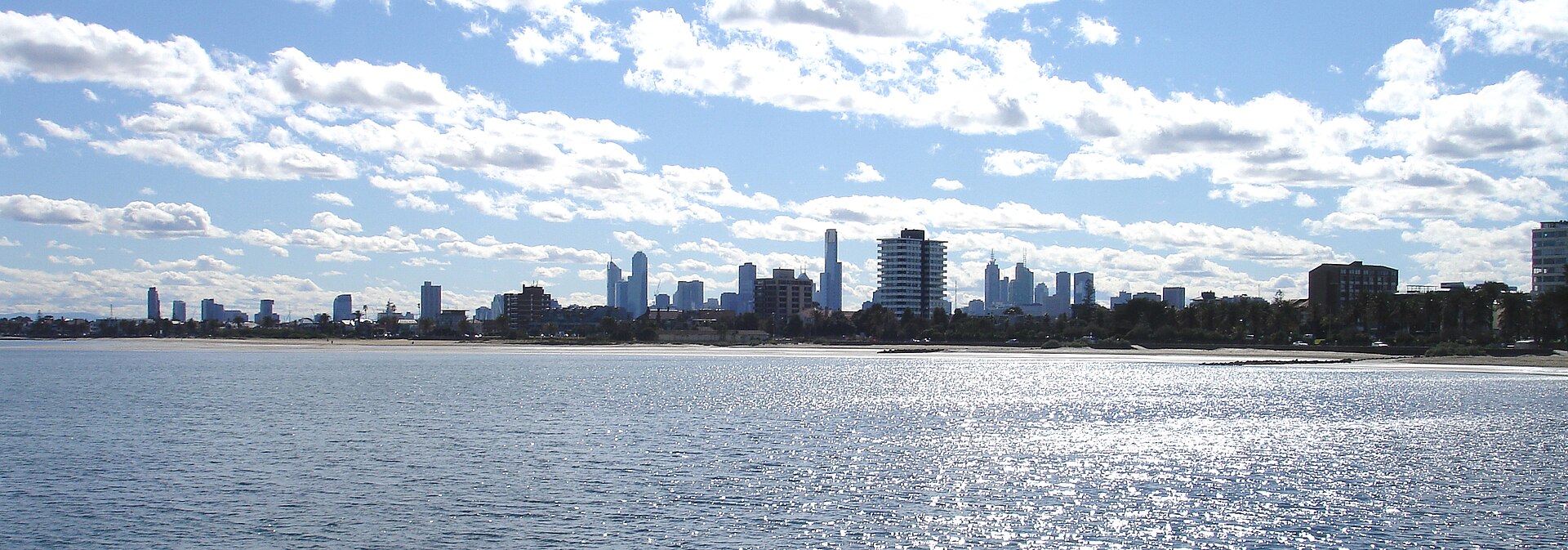

Melburnians say it constantly, usually while removing a jacket they put on forty minutes earlier: four seasons in one day. Visitors assume it is the sort of exaggeration every city makes about its weather. It is not, quite. Melbourne genuinely does experience abrupt within day swings of a kind that are unusual for a temperate coastal city, and the reason is a specific and explicable piece of geography. Understanding the mechanism is more useful than memorising the joke, because it tells you what to carry and when.
The city sits at about thirty eight degrees south, on the northern shore of Port Phillip, in the latitude band where the belt of migrating high pressure systems that crosses southern Australia meets the procession of cold fronts spinning off the Southern Ocean. To the north is a very large, very dry continental interior that gets extremely hot in summer and cold at night in winter. To the south is deep ocean whose surface temperature barely moves across the year. Melbourne sits on the seam between those two air masses, and the weather is essentially a question of which one is currently winning.
The cool change
The signature event is the cool change, and once you have seen one you can recognise the setup. A high pressure system positions itself in the Tasman Sea and the resulting circulation drags air southward out of the interior. The wind at ground level goes to the north, the temperature climbs, the humidity drops and the sky takes on a dirty white cast from dust and, in bad summers, smoke. Then a front approaches from the west, the wind swings hard to the south west, and cold marine air arrives. Meteorological accounts of Melbourne's climate note that the temperature can fall by about ten degrees Celsius within twenty minutes when this happens.
That single fact accounts for almost everything else people say about the city's weather. It is why a summer forecast of thirty six degrees can be followed by an evening at eighteen. It is why the change is a public event, discussed on the radio and watched for on the western horizon, and why outdoor events in Melbourne are planned around the timing of a front rather than around a daily maximum. It is also why the local convention on clothing is layers plus something windproof, and why a city with a reputation for wearing black is in practical terms a city wearing a jacket it can take off.
Winter runs the same machinery in reverse. Anticyclones sitting over the interior deliver persistent westerly flow, and when a depression deepens to the south east a cold outbreak pushes cold, relatively dry air rapidly across Victoria, producing squally showers, hail and, on rare occasions, snow at sea level. Melbourne's heaviest recorded snowfall was in the middle of the nineteenth century, when snow was reported lying in city streets to a depth of about thirty centimetres. It is not a thing that happens now, but it is a reminder of how far south the city is: Melbourne is closer to the pole than any major city on the Australian mainland except Hobart's smaller neighbours across Bass Strait.
The rain, and the drought that changed the plumbing
Melbourne's rainfall is one of the most misunderstood things about it. The city has a reputation for being wet, and it is not. Its annual total is modest, considerably lower than Sydney's, and it is distributed fairly evenly across the year rather than concentrated in a wet season. What Melbourne has is a large number of days with a small amount of rain, delivered as showers behind fronts, which is why it feels perpetually drizzly to arrivals from cities where rain is heavier and rarer. The practical consequence is that an umbrella is often less useful than a hood, because the rain arrives sideways with the wind behind it.
The long drought that gripped south eastern Australia from the late 1990s until around 2010 reshaped the city physically. Storage levels fell far enough that permanent water restrictions became normal, front lawns disappeared across the suburbs and were replaced with drought tolerant planting, rainwater tanks appeared behind thousands of houses, and the state built a large desalination plant on the coast in Gippsland at considerable expense and considerable political cost. Then the drought broke, and within a couple of years the same region was flooding. If you want to understand why Melburnians are simultaneously fatalistic and obsessive about weather, that decade explains a good deal of it.
Two other patterns are worth knowing. The urban heat island effect is pronounced in the treeless middle and outer suburbs, where summer nights can stay several degrees warmer than in leafy inner suburbs with mature elms and plane trees, which is one reason the City of Melbourne and neighbouring councils treat canopy cover as a public health measure rather than an amenity. And Port Phillip moderates temperatures near the shore, so a February day can be markedly cooler in Williamstown or Brighton than in Sunbury or Werribee.
The claim to be sceptical about
Any discussion of Melbourne's climate eventually collides with the liveability ranking. Melbourne topped the Economist Intelligence Unit's Global Liveability Index for seven consecutive years from 2011 to 2017, and the city has never stopped mentioning it. The scepticism is warranted, and not because the result was rigged. The index was designed to help employers set hardship allowances for relocating expatriate staff, it scores a small number of cities on stability, healthcare, culture, environment, education and infrastructure, and its methodology systematically favours mid sized, wealthy, stable, English speaking cities in countries with universal healthcare. It says nothing about housing affordability, which is where Melbourne performs badly. Treating it as an objective verdict on the world's cities is a category error, and one the city has been happy to make.
The weather itself is also less exceptional than the slogan implies. Plenty of places in the mid latitudes have volatile frontal weather, and Melbourne's swings are not the most extreme in the world. What is genuinely distinctive is the combination: a hot dry continent immediately upwind in summer, a cold ocean immediately upwind at all times, and a large city sitting precisely where the two meet, in a latitude where fronts pass every few days. The phrase four seasons in one day, which most Melburnians associate with a song written by a New Zealander who lived here, describes that seam accurately enough. The practical translation is simpler. Check the forecast in the morning, check it again at lunch, and take the jacket.
References
- eMelbourne, The Encyclopedia of Melbourne Online, University of MelbourneClimate
- Bureau of MeteorologyClimate statistics for Melbourne (Olympic Park)
- Bureau of MeteorologyClimate statistics for Melbourne Regional Office
- WikipediaClimate of Melbourne
- WikipediaGlobal Liveability Ranking
This is a reference article, written from the sources above. It is background, not news reporting.