Botanic gardens as the city's green lungs
Reference library · 1100 words
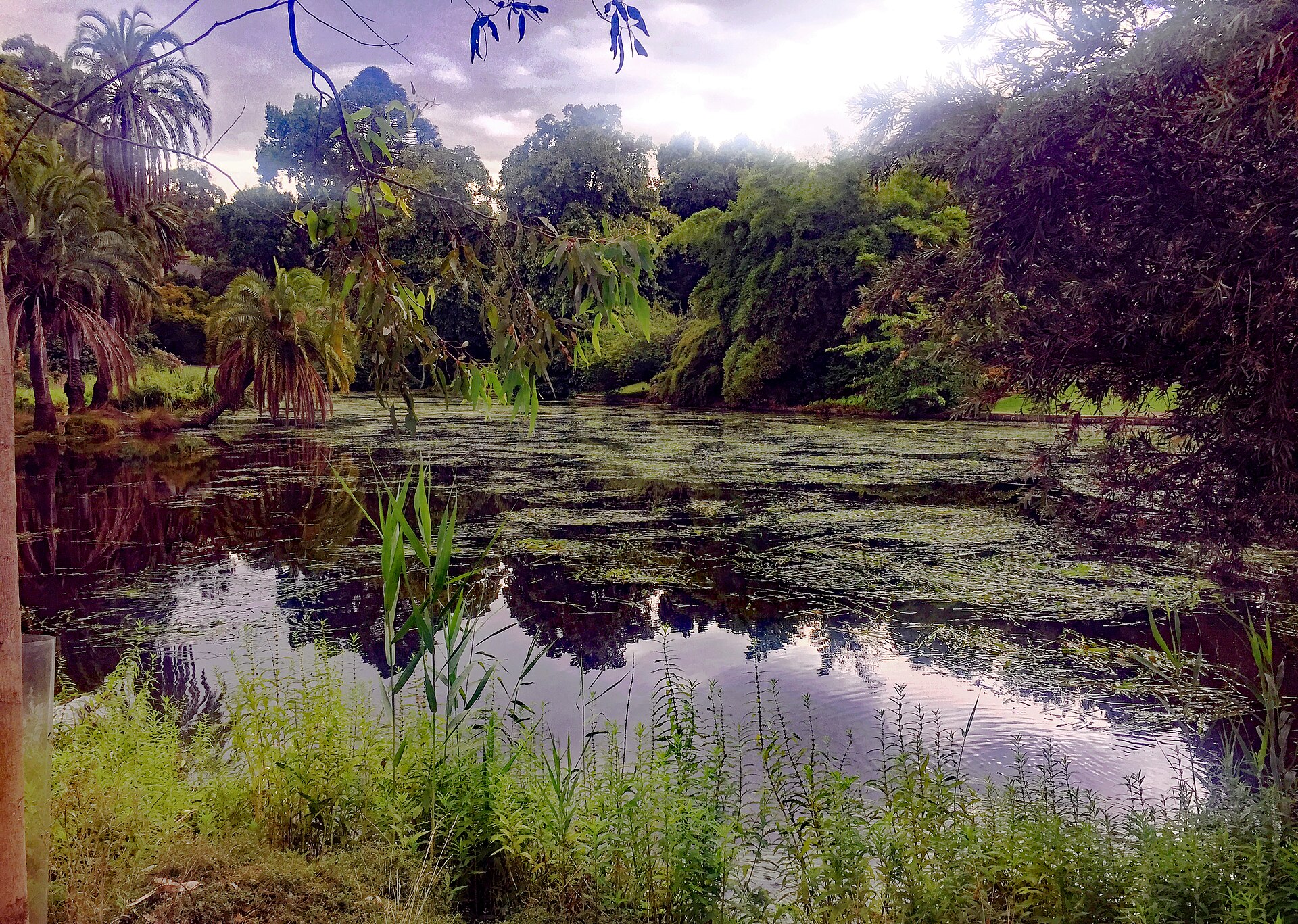

Melbourne set aside land for a botanic garden on the south bank of the Yarra in March 1846, only eleven years after the settlement began. That is remarkably early for a colonial town of a few thousand people, and it was not an act of aesthetic generosity. Botanic gardens in the nineteenth century were instruments of empire: places to acclimatise economically useful plants, to test what would grow in a new colony, and to distribute seed. The garden that resulted, now the Royal Botanic Gardens Melbourne, covers close to forty hectares on the river's edge below South Yarra, and it is the most heavily used open space in the city.
The land is Country of the Kulin Nation peoples, the Wurundjeri Woi Wurrung north of the Birrarung and the Boon Wurrung to the south, and the low ground the gardens occupy was part of the river's floodplain, with billabongs and swampy flats that were later drained and reshaped. The gardens today run an Aboriginal heritage walk led by Aboriginal guides, which is the appropriate place to hear about the plants and their uses from the people whose knowledge it is.
Two directors and two ideas of a garden
The character of the place is the product of an argument between its first two great directors. Ferdinand von Mueller, appointed Government Botanist in the 1850s and director from 1857, was a scientist of international standing who founded the National Herbarium of Victoria and used the gardens as a research collection. He laid out systematic beds arranged by plant family, corresponded across the world, and named a very large number of Australian species. To Mueller, a botanic garden was a laboratory, and its purpose was knowledge.
William Guilfoyle, who succeeded him in 1873 and stayed until 1909, thought a botanic garden was a landscape. He swept away much of Mueller's systematic layout and remade the grounds in the picturesque manner: broad lawns, curving paths, carefully composed vistas, dense plantings of foliage contrast, and the Ornamental Lake formed in the low ground of a former billabong. The result is what visitors now recognise as the Melbourne gardens, and it is one of the finest nineteenth century landscape gardens in the southern hemisphere. Mueller never forgave him, and the argument between science and scenery is still visible on the ground. The word Royal was added to the title in 1958.
Around the gardens sits a larger green precinct that most people treat as one place. The Tan, a gravel track of roughly four kilometres around the perimeter, is Melbourne's best known running route and is a social institution as much as an exercise one. The old Melbourne Observatory, built in the 1860s, stands at the Birdwood Avenue edge. Across the road is the Shrine of Remembrance, completed in the 1930s, and beyond it the Domain parklands run back toward the river. Together they form an almost unbroken belt of open space between the central city and the inner south east.
The other lungs
The botanic gardens are the most famous but not the largest. Royal Park in Parkville is the biggest park in the City of Melbourne, and it is a different kind of place entirely: not a designed garden but a broad open expanse containing Melbourne Zoo, established in the 1860s, sports fields, and substantial areas replanted with indigenous grassland and eucalypts. It was from Royal Park that the Burke and Wills expedition set out in 1860.
Then there is the ring of Victorian era gardens around the Hoddle Grid, which is the real reason central Melbourne feels less enclosed than its density would suggest. Fitzroy Gardens and Treasury Gardens to the east, the Carlton Gardens to the north with the Royal Exhibition Building at their centre, Flagstaff Gardens to the west on the rise that was the settlement's first burial ground, and the Domain to the south. These were reserved early, when land was cheap and governors were confident, and their survival is the single most valuable planning inheritance the city has.
Their trees are a peculiar asset. Melbourne's nineteenth century avenues were planted heavily with English elms, and because Dutch elm disease has never reached Australia, the city holds one of the most significant populations of mature elms left anywhere in the world. The avenues in the Fitzroy Gardens and along St Kilda Road are, in a literal sense, a European heritage that Europe no longer has. They are also ageing, water hungry and vulnerable, which is why the councils fuss over them so publicly.
What green lungs actually do
The phrase itself deserves a correction. Urban parks are not meaningfully significant to a city's oxygen supply; the atmosphere does not work that way, and the metaphor is a nineteenth century inheritance from a period that understood disease as bad air. What parks genuinely do in a city like Melbourne is regulate heat and water, and both functions have become urgent.
Temperature is the clearest case. A large treed park can be several degrees cooler than the surrounding hard surfaces on a hot day, and in a city that regularly exceeds forty degrees in summer that difference is a public health measure rather than an amenity. Canopy cover is distributed very unevenly, concentrated in the older inner suburbs and thin across the outer growth areas where it is needed most, and that inequality maps onto income. The City of Melbourne has pursued an urban forest strategy aimed at substantially raising canopy cover and diversifying species so that a single pest or drought cannot take out a whole avenue. As part of that work the council gave individual street trees identifying numbers and contact addresses so that residents could report problems, and people began writing letters to the trees instead, which is a small and genuinely charming piece of municipal history.
Water is the second function. The long drought of the 2000s nearly destroyed a number of Melbourne's historic plantings and forced a fundamental rethink. The botanic gardens and the major parks now rely heavily on captured stormwater and recycled supply rather than drinking water, plantings have shifted toward species that can survive a dry decade, and the Royal Botanic Gardens has developed a second site at Cranbourne devoted specifically to Australian plants, where an extensive Australian garden opened in stages through the 2000s and 2010s. That shift, from a nineteenth century collection of European and exotic species watered without limit to a twenty first century landscape designed for a drying climate, is the most important thing happening in Melbourne's parks, and it is happening quietly, one replanted bed at a time.
References
- eMelbourne, The Encyclopedia of Melbourne Online, University of MelbourneRoyal Botanic Gardens
- eMelbourne, The Encyclopedia of Melbourne Online, University of MelbourneParks and Gardens
- Royal Botanic Gardens VictoriaAboriginal Heritage Walk
- City of MelbourneUrban Forest Strategy
- WikipediaRoyal Botanic Gardens Victoria
This is a reference article, written from the sources above. It is background, not news reporting.