Boom era architecture and its lasting swagger
Reference library · 1090 words
.jpg)
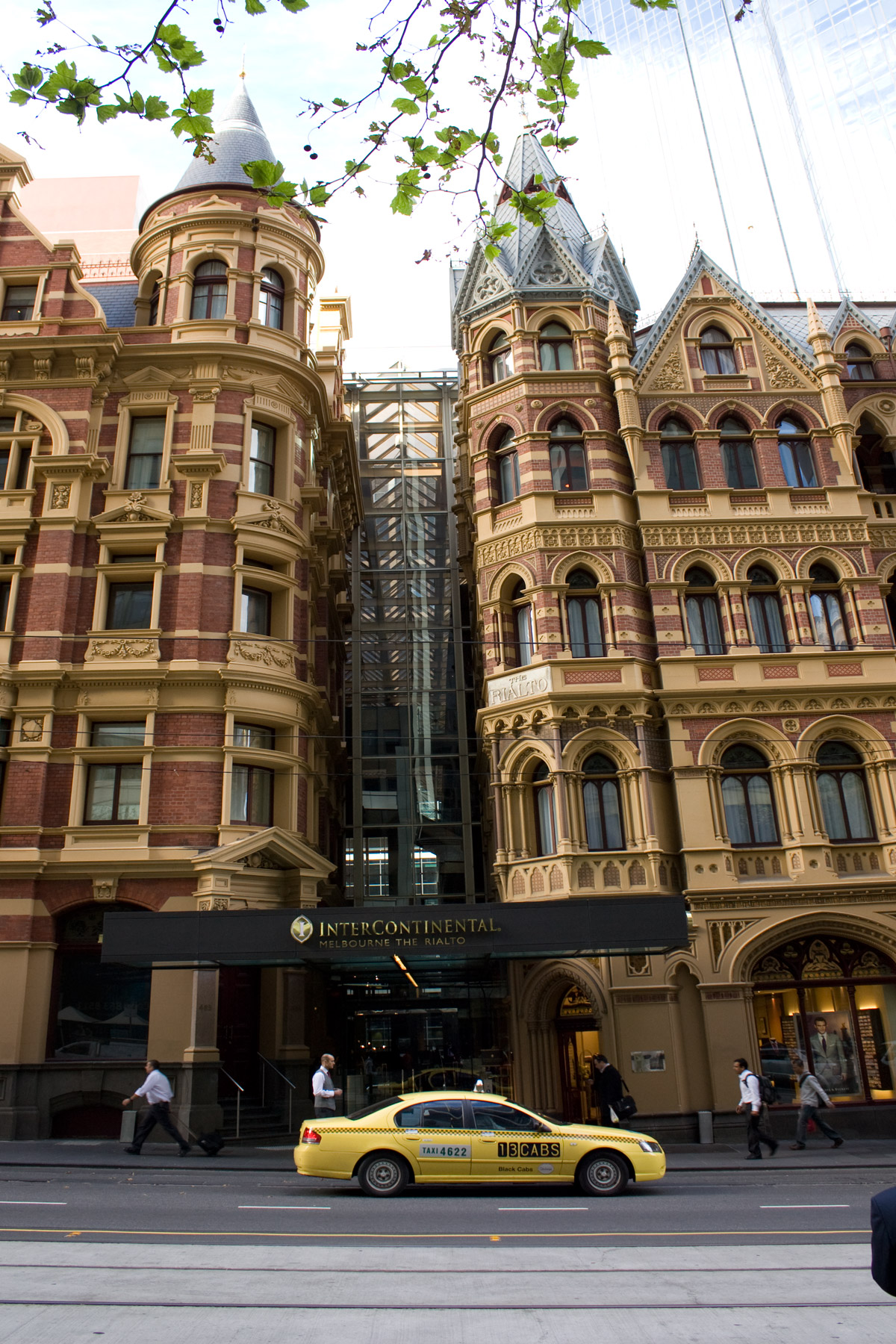
Walk the western end of Collins Street, below Queen Street, and the buildings stop behaving like offices. Pointed arches, banded stonework in contrasting colours, carved capitals, and towers that serve no purpose except to be seen from further away. The Rialto Building of 1889, the Olderfleet Building of the same year and the Old Stock Exchange of 1888 to 1891 were all designed by William Pitt in a Venetian Gothic manner borrowed from a city of canals and applied to a colonial port that was fifty years old. They are unembarrassed buildings, and the swagger is the point.
That confidence had a name. In 1885 the London journalist George Augustus Sala visited and, in articles syndicated back to the Daily Telegraph, called the place Marvellous Melbourne. His public lectures here were poorly attended, which is a small joke history has kept, but the phrase caught precisely because the city was in the middle of something extraordinary. Between roughly 1883 and 1889 Melbourne went through a period of real estate inflation that contemporaries and historians alike simply call the land boom. At its height around 1888 and 1889, land values in parts of the central city reached levels comparable to central London, and building activity in the city rose by more than half at a time when national output grew by around a quarter.
Where the money came from
The buildings were not paid for out of Melbourne's pocket. Cheap capital from London flowed into Australian banks and building societies, which lent it out for railways, tramways, suburban subdivision and speculative construction. Population was rising, the colony's confidence was high, and speculation on land became, in the encyclopedia's phrase, a mania. Understanding that the money was borrowed and foreign explains both the scale of the architecture and the speed of its ending.
The public buildings were more sober but no less ambitious. Joseph Reed's Royal Exhibition Building, put up in Carlton Gardens between 1878 and 1880 for the international exhibition, was later the first Australian building inscribed on the World Heritage List. Parliament House was built in stages from 1856 to 1892 and remains unfinished, still lacking the dome its designers intended. The State Library and the National Gallery grew by accretion across a century from 1854. By the early 1900s Collins Street was being compared to Friedrichstrasse in Berlin and Kaerntnergasse in Vienna, which tells you what Melbourne thought it was.
The oddest survivals from the period are the coffee palaces. These were enormous temperance hotels, built to offer everything a pub offered except the drink, and Melbourne had over fifty of them by 1888. The politician and property developer James Munro built several, including the Victoria in 1880 and the Federal in 1888; the Federal had four hundred bedrooms and was among the largest hotels in the country. Almost every one of them eventually took a liquor licence, which was the entire point they had been built to refute. The Grand became the Windsor Hotel and still stands on Spring Street opposite Parliament. The Federal was demolished in 1973.
The ballast story, and other things that are not true
Anyone who spends time in Melbourne will eventually be told that the cast iron lace on the verandahs of Carlton and Fitzroy arrived as ballast in the holds of ships that had come out empty for wool. It is a lovely story and it does not survive contact with the facts. Ballast is cheap bulk material: rock, sand, pig iron, whatever is heavy and expendable, to be dumped on arrival. Decorative cast iron is a manufactured product, cast from patterns, sold from illustrated catalogues, and often carrying the foundry's name on the casting itself. A great deal of Melbourne's ironwork was made in local foundries in Collingwood and Fitzroy, and the rest was shipped from Britain as ordinary paid freight. The ballast tale is repeated because it sounds like something a resourceful young colony would do.
The second correction concerns Marvellous Melbourne itself, which is usually quoted as though the city took the compliment and kept it. It did not. Within a few years the phrase had been turned into Marvellous Smellbourne, a reference to a drainage and sewerage system that had not kept pace with growth, and Murderous Melbourne, a reference to typhoid. After the crash it was used mainly as a lament. It lay dormant until historians revived it, and was then picked up as a tourism and investment slogan in the 1990s, stripped of every ironic layer it had accumulated.
The third is that the boom architecture stands as a monument to sustained prosperity. It is a monument to about six years. The Baring crisis in London in 1890 frightened British investors into recalling their Australian capital, the banks and building societies failed between 1890 and 1893, and the depression that followed was the worst the country had experienced. Munro, the coffee palace builder, was among those ruined. Historians still argue about how much was internal weakness and how much external shock, and the sensible answer is both. The city's population growth reversed and the psychological effect lasted decades.
Why so much of it is still standing
Two accidents preserved what we have. The first is that the crash was so total that almost nothing was built over the boom stock for nearly forty years. The second is a height limit of 132 feet, roughly forty metres, imposed in 1916, which prevented anything resembling a skyscraper through the interwar decades and left the nineteenth century skyline substantially intact. Melbourne's centre still had a low, even parapet line into the 1950s.
The limit broke in 1958 with ICI House, designed by Bates Smart and McCutcheon, the city's first true curtain walled tower and the building that started everything that followed. Through the 1960s and 1970s the rebuilding was ferocious, and a great deal of boom era Melbourne came down, the Federal Coffee Palace among the more notorious losses. The heritage movement that grew out of those demolitions is why the Rialto and the Olderfleet were not simply cleared: instead their facades were retained and a tower was built behind them in the 1980s, a compromise that pleases nobody entirely and preserves the street.
What is left, then, is not an intact Victorian city. It is a set of fragments from a six year speculative frenzy, saved partly by a depression, partly by a planning rule, and partly by people who fought for them in the 1970s. The swagger is genuine. So is the fact that it was borrowed.
References
- eMelbourne, The Encyclopedia of Melbourne OnlineLand Boom
- eMelbourne, The Encyclopedia of Melbourne OnlineMarvellous Melbourne
- eMelbourne, The Encyclopedia of Melbourne OnlineArchitecture
- eMelbourne, The Encyclopedia of Melbourne OnlineSkyscrapers
- eMelbourne, The Encyclopedia of Melbourne OnlineCoffee Palaces
This is a reference article, written from the sources above. It is background, not news reporting.