Autumn's slow turn along a tree lined street
Reference library · 1051 words
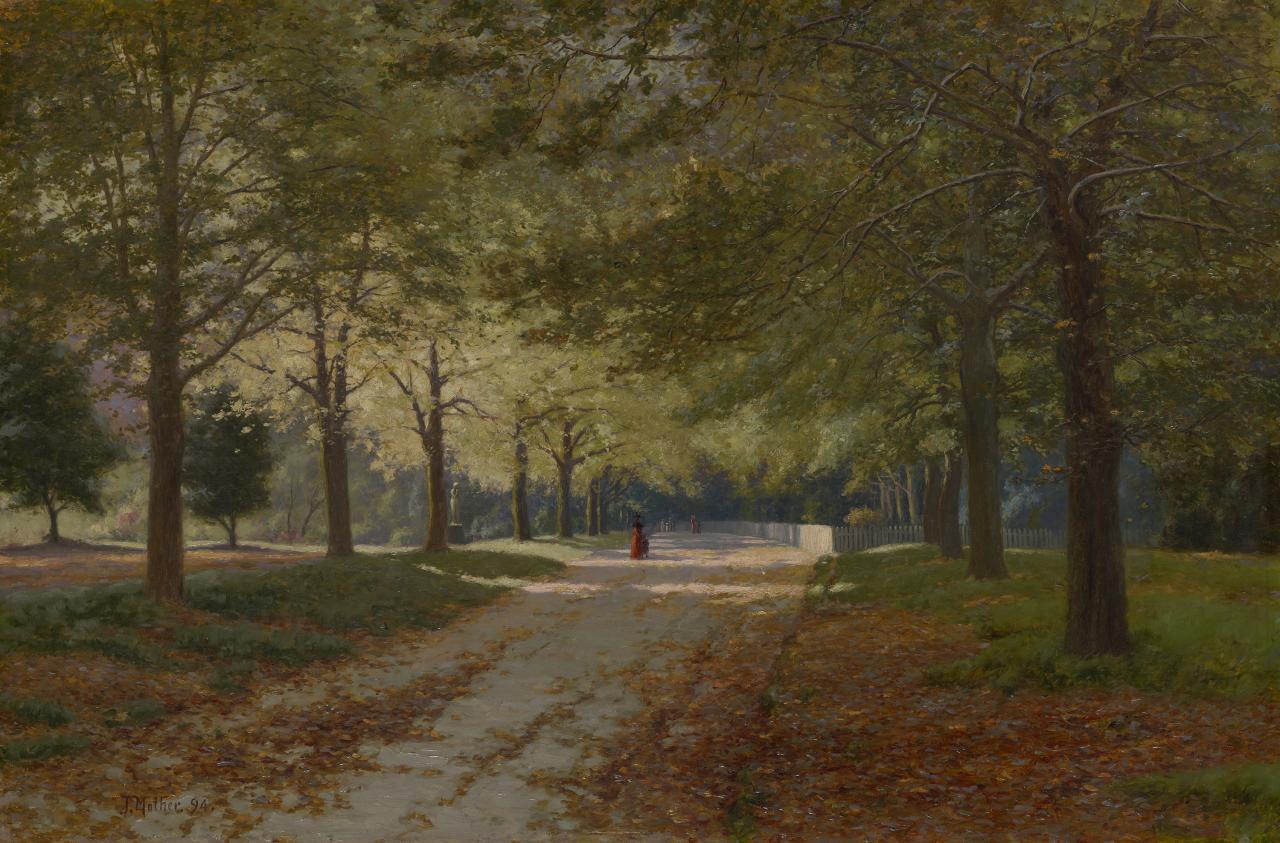

Between about the middle of April and the middle of May, certain Melbourne streets do something that no Australian landscape does on its own. The elms along Royal Parade in Parkville, along Victoria Parade in East Melbourne, and through the Fitzroy Gardens and Carlton Gardens turn yellow and then a deep russet, drop everything within a few weeks, and leave a bare grey armature of branches over the road. It is the most obviously European thing about the city, and it is entirely manufactured.
The eucalypts that covered this country before 1835 do not do this. River red gums, some of which still stand in Royal Park and in Yarra Park beside the Melbourne Cricket Ground, hold their leaves year round and shed bark rather than foliage. The seasonal drama Melburnians photograph every April belongs to species carried here deliberately, planted in avenues, and maintained at considerable public expense ever since. Autumn colour in Melbourne is a piece of nineteenth century cultural policy that happens to be beautiful.
How the trees got there
The planting began almost immediately. The earliest elms in Melbourne went into the Royal Botanic Gardens around 1845, within a decade of the settlement. Significant avenue plantings followed at the Fitzroy Gardens in 1859, along Victoria Parade between 1878 and 1890, and along Royal Parade in 1897 and again between 1910 and 1915. Those dates line up with the reservation of the great parks, most of which were set aside as Crown land before 1854 by Charles La Trobe: Royal Park, Princes Park, Fawkner Park, Yarra Park, the Carlton and Fitzroy Gardens and the Botanic Gardens.
Two things made the plantings possible. One was ideology. Colonists wanted a landscape that looked like the one they had left, and elms in particular were prized for their shape, their shade and their tolerance of hard urban conditions. The other was water. The Yan Yean reservoir came into service in 1857 and gave Melbourne a reliable supply, which is what allowed ornamental gardens and long street avenues to be kept alive through a dry summer. Without Yan Yean the elm avenues would not have survived their first decade.
Melbourne kept planting exotics for the rest of the century. Conifers including bunya, hoop and Norfolk Island pines, Moreton Bay figs, cedars, cypress and, from the 1880s, Canary Island date palms all went into the parks and boulevards. Plane trees became a standard street tree because they tolerate compacted soil, pollution and severe pruning better than almost anything else. The result is that the tree canopy of inner Melbourne is largely a botanical collection from four continents, arranged along the lines Hoddle drew.
The accident of the elms
The elms matter for a reason nobody planning them could have anticipated. From the mid twentieth century Dutch elm disease, a fungal infection spread by bark beetles, destroyed elm populations across Europe and North America on an enormous scale. Australia has never had an outbreak. As a consequence Melbourne now holds one of the largest and finest populations of mature elms left anywhere in the world. Something over six thousand elms grow in the streets and parks of the City of Melbourne alone, with roughly eleven thousand within ten kilometres of the centre, dominated by English elm and Dutch elm with later additions such as golden wych, weeping wych and Chinese elm.
This is a genuine act of custodianship rather than luck alone. Quarantine controls, a dedicated pest and disease task force and volunteer groups exist specifically to keep the disease out and to manage introduced pests that already attack the leaves. It is also a vulnerability. A single accidental introduction could take down avenues that took a hundred and twenty years to grow, and the population is ageing more or less in unison because it was planted in a handful of concentrated campaigns.
What autumn actually feels like
The colour is only part of it. Autumn is the season in which Melbourne's weather is least likely to be extreme. Summer here is defined by the collision of hot air drawn down from the interior with cold fronts arriving off the Southern Ocean, which is where the city gets its reputation for four seasons in one day and the occasional catastrophic hot northerly. By March that pattern is winding down and the winter westerlies have not yet established themselves. Mean daily maximum temperatures slide from the low twenties in March to the mid to high teens by May. Rain arrives in the form Melbourne specialises in: frequent light showers rather than downpours, spread across a great many days.
It is worth correcting one thing about that. Melbourne has a reputation as a wet city, and the reputation is wrong in the way people usually mean it. Annual rainfall averages around 600 millimetres, considerably less than Sydney or Brisbane. What Melbourne has is a large number of rain days, something like 139 a year, and the fewest clear days of any Australian capital, fewer than fifty. The city is not wet so much as grey and drizzly, which is a different complaint entirely.
The other correction concerns the calendar. The four season year, with autumn running through March, April and May, is a European import applied to a place it does not fit especially well. The seasonal knowledge held by Wurundjeri Woi Wurrung and Boon Wurrung people tracked the land through indicators such as the flowering of particular plants and the movement of particular animals, and did not divide the year into four equal blocks. Anyone who has watched a Melbourne April deliver a 30 degree day followed by a week of drizzle already suspects the four season model is doing rough work here.
Still, for a few weeks the imported version holds. The best places to see it are simply where the oldest avenues are: Royal Parade running north from the University of Melbourne, Victoria Parade beside St Patrick's Cathedral, the elm avenues of the Fitzroy Gardens, Alexandra Avenue along the Yarra, and the tree lined stretch of St Kilda Road between the Shrine of Remembrance and the river. Trams 19 and 109 run under two of the finest of them, which means the cheapest way to see a Melbourne autumn is to sit on the left hand side of a tram and look up.
References
- eMelbourne, The Encyclopedia of Melbourne OnlineElm Trees
- eMelbourne, The Encyclopedia of Melbourne OnlineTrees
- eMelbourne, The Encyclopedia of Melbourne OnlineParks and Gardens
- WikipediaClimate of Melbourne
- Royal Botanic Gardens VictoriaMelbourne Gardens
This is a reference article, written from the sources above. It is background, not news reporting.